

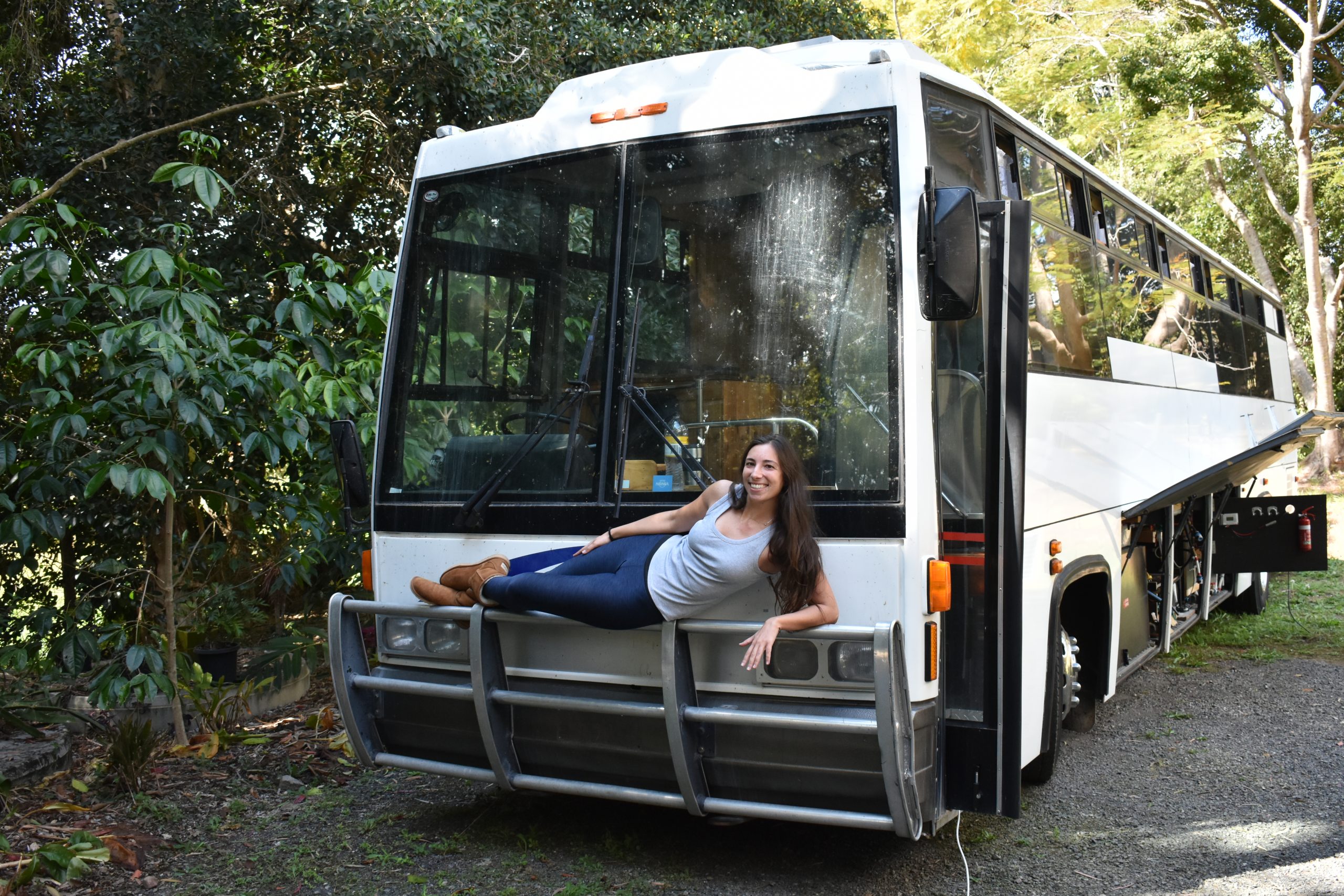
5 Things to Check Before You Buy a Bus (That You Want to Convert to a Motorhome)
This is Aaron speaking: Around this time three years ago, I had no idea that one day I would be living in a bus travelling around Australia. Back then, I had just got out of (what I thought at the time) a serious relationship. An event like that leads to awkward questions. Like:
Where was I heading in life, what did I want to do? And why, why, WHY FOR THE LOVE OF EVERYTHING HOLY is there always hair clogging up the shower drain?!? (Gents, you know the struggle.)
Anyway, I decided I wanted to own a house. Don’t ask me why or what was going through my head at the time, because I don’t think I’d be able to tell you. Maybe I wanted stability, maybe I wanted something that was just mine, dammit!
What I got, as well as those things, was debt. And I found out; I hate being in (it was a lot) debt.
I should also mention that shortly after getting a house and before moving in, I met Chiara and learned that I was wrong about almost everything (apparently). Again, gents will know the struggle.
Cut to last year sometime, when we made the decision to sell up and buy a bus and travel Australia.
We had a buyer lined up for my house, and around 3 months to find a bus to convert into a motorhome.
After much deliberating, research, arguments, beers and Google searching we found our bus. And it was great. We were lucky enough to find one with a lot of work already done to it (which we needed, because the clock was ticking down on the move-out date).
In the process of looking however, we came up with a list of must-haves when searching for a bus to convert into a motorhome (or tiny home, or into a liveable and movable house).
And for your reading and viewing pleasure, I’ve written them down for you. Because you’re just awesome, you.
Note: I’m assuming you’re going to be buying a bus in running/working condition i.e. the motor runs and it drives well. No point buying a bus to convert that needs mechanical work, unless you’re into that sort of thing. Weirdo.
Note 2: This article doesn’t cover the size/dimension/functions of the bus regarding design. That will come in a later article. This article states things to check before buying any sort of bus.
1. Let’s Talk About Rust, Baby

When looking for a bus to convert (or any vehicle in general really), one of the first things I look for is rust. Rust is the process of iron (or alloys containing iron, like steel) corroding into iron oxide (in the presence of oxygen and/or moisture). This corrosion process weakens the base metal, and if left unchecked will completely convert the whole metal piece and destroy its usefulness completely.
Which is just a fancy way of saying: Rust = Bad News.
You do not want rust on your bus.
If you must budget (lucky you) to be able to purchase a brand-new bus to convert, that’s great. It’s unlikely that a new vehicle will have any rust.
However, if you’re like the rest of us mere mortals we will have to buy second hand, and that means that you will find rust somewhere on your prospective bus.
That’s not such a bad thing, as longs as it’s only minor surface rust (it hasn’t affected deep into the metal, and it’s a small size). Minor rust is relatively simple to fix and finding it can be a bargaining chip to drop the price.
What you DO NOT want is rust that has eaten through the thick metals on your chassis or any of your running gear (suspension, transmission, engine block etc). If you spot major rust on your prospective purchase, either be prepared to walk away or spend time and money trying to fix it.
2. Tyres – They Can Be Tiring…
Sorry about the title, but you try thinking of a good one about tyres (seriously, if you can, comment it below and save us all from bad writing).
The next thing to look at when purchasing a bus is the tyres (or tires if you live in the U.S or Canada). Tyres can be a big expense on a big vehicle like a bus, and it’s not something you want to be paying for any time soon. Also, tyres are the grippy things keeping your vehicle on the road, so it’s important safety-wise to find good ones.
Basically, what you want to find is tyres with a good depth of tread (how much rubber is left on the tyre) and the condition of the rubber (not fading/perished and with no missing chunks). You should try and find a vehicle with new (under a year is optimal) tyres if you can. You can check how old the tyre is by the serial number printed on the sidewall of the tyre (if you don’t know how to do this, this article here will explain).
3. Check for Leaks
If the potential vehicle has been parked in the same spot for a while, it’s always a good idea to check underneath it for evidence of fluid leaks. These can take the form of dark oily splotches and drops underneath the engine and transmission.
Also, if you’re vehicle has compressed air system – like air brake, air suspension, doors and seats – it would pay to do due diligence in checking that for leaks as well. An easy way to do this is with simple soapy water – just splash and rub it on and check for bubbles (a sign of air escaping). We were caught out with this about a month after we moved into the bus, one of the airbags on the front suspension gave up and needed to be replaced. Not a big deal, but not ideal either.
Again, it isn’t a complete deal-breaker, but if you go ahead and purchase the vehicle knowing it has leaks, you will have to fix them at some stage in your travels. It would be easier to buy a vehicle that is mechanically sound straight up (especially if you’re in a hurry – like if you’ll be homeless in three months).
4. Don’t Be a Mechanic’s Best Friend
This needs to be stated, even though it’s common sense.
Try to find a bus that is as mechanically sound as you can. Do all the electrics (lights, flashers etc.) work? Does the engine run smooth (no weird noises, no loose/squealing belts, no knocking or ticking sounds)? Do the brakes work (REALLY IMPORTANT!!)? Does it drive?
Because unless you want to play around with the mechanical side of things (you’re a special group if you do), you are much better off finding a bus that is mechanically fine.
If that means you shop around for a few months until you do, great, do that. Because there would be nothing worse than starting your travels and then getting stuck somewhere because of a break-down.
Also, finding a bus that is mechanically sound is just one less thing you must worry about, honestly. Trust me, you will have SO MUCH else to think about, and if you can save some brainpower by not worrying about fixing your motor/transmission/running gear the better off you’ll be.
If you’re not mechanical (like me), you can always get someone that is to come check over your prospective bus. A local mechanic would be happy to do it, or you could bribe, threaten or blackmail a mechanical friend to come with you. A small cost initially beats a potential large cost down the line.
5. Floor It
If you’ve gone over the outside of the bus and the motor/mechanical side, the next thing to look at is the internal floor inside the bus. This is one of the less critical aspects of buying a bus but seeing as the floor is the foundation on which you will be building the interior, it’s worth trying to find a decent floor.
Some busses have floors that slope gently to the front of the bus. Some buses have steps. Some (usually older but not always) buses have floors that have seen better days (bad rust, dents and scrapes etc.).
What you want to look for in a bus is a level, flat floor with no-to-minimal rust. As in, if the bus is parked on level and flat ground, the floor should also be level and flat.
Again, it’s not a big deal if your potential bus doesn’t have the best floor, if you know you will have to address it when you start your build.
Final Thoughts
So that’s it, in a nutshell, of what you should look at when hunting around for your bus. None of these points is a total and absolute deal-breaker (within reason, no bad rust remember?) if you can accept the consequences. As in, if you buy something knowing it has a problem, it will be your responsibility to fix it.
When you do go bus shopping, you should try to not fall in love with any bus. Trust me, there are plenty more fish in the sea (who else hates this saying?) and your “perfect” bus might be right around the corner.
Until next time,
Stay Wild and Free!
Aaron & Chiara


Mick
Interesting comments. We are looking to sell up and travel also, and are keen to get a bus.
A couple of thoughts on that:
1) Mechanical condition is a no brainer; I’d suggest having any bus you’re wanting to buy be checked out by a reputable heavy vehicle mechanic (preferably one familiar with the make of vehicle you are considering purchasing).
2) Insofar as rust in the frames is concerned, when we look at (converted) buses, the first thing we tend to rule them out on, is where they haven’t had the roof lifted – for two reasons.
Firstly, unless the vehicle originally had a flat floor and good roof height, it’s going to be difficult to sell later on.
Secondly (and most importantly), if they’ve had the skins off, they’ll have had to inspect/replace the frames for the roof lift anyway – “guaranteeing” in effect, minimal rust.